You're not selling haircuts, you're selling a feeling
Five things barber school left out, from the break-even number most barbers never run to the clients who vanish without a word.
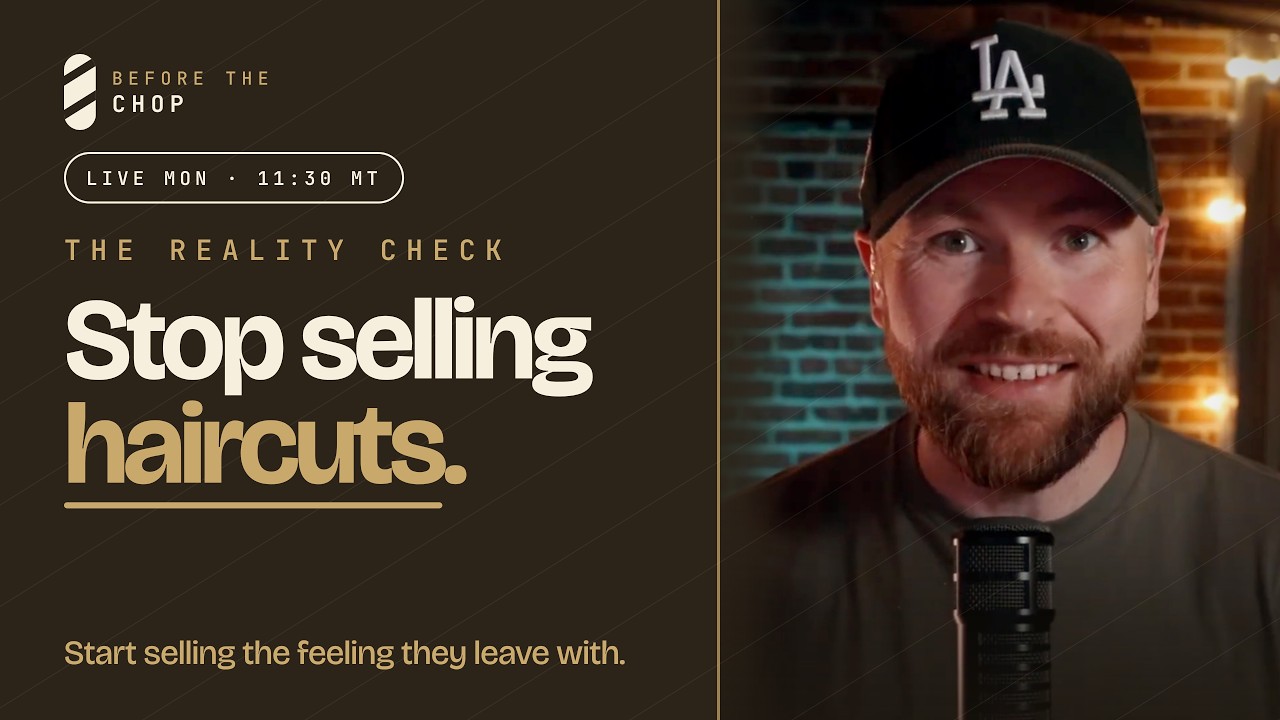 29:31
29:31
Barber school taught you how to cut hair. It did not teach you how to be a barber. Those are two different jobs, and you got hired for both on the same day.
You've had this day: fully booked, cuts went well, clients tipped on the way out. And you drive home and something doesn't add up. It's not the haircuts. Something else, something you can't quite name. This is my attempt to name it. Five things that catch almost every barber off guard, none of them on the state board exam.
There's a barber I knew, first year in, technically solid, hired at a decent shop. Three months in she's doing fine on cuts, but she can't figure out why certain clients come back and certain ones don't. She isn't losing them to bad haircuts. She's losing them to something she can't see yet. What she was missing is these five things. I'll come back to her.
You're not selling haircuts, you're selling a feeling
The cut is the proof. It's how you back up the feeling. But the reason a client comes back, and the reason they don't, is only sometimes about the technical execution.
Think about the best client relationship you've seen or been part of. That barber isn't necessarily the most technically gifted person in the shop. They're the person the client trusts. They remember the last haircut. They ask about the kid's soccer game. They manage the energy of the interaction, and the client leaves feeling seen, not just cut.
The barbers who figure that out are years ahead of the ones who keep chasing the perfect fade and wondering why the book isn't growing.
And I'll say the sharper version of this, because some barbers need to hear it. Most clients are not qualified to evaluate your technical work. They don't know the difference between a perfect taper and a good one. What they do know is how they feel walking out of that chair. They know if you remembered their name, if you asked about the game last weekend, if you were present with them or already thinking about the next cut. The clients who rebook, refer their friends, and stick with you through a price increase aren't doing it because your blends are three percent cleaner than the barber down the street. They're doing it because of something between you and them that they can't explain but can absolutely feel.
I've watched genuinely gifted barbers, people I'd put up against anyone technically, struggle to build a book. And I've watched solid, consistent, not-flashy barbers build packed schedules because their clients love coming to see them. Not their haircuts. Them.
If you have to choose where your energy goes this season, put it into the clients. The craft will keep developing. The book won't build itself while you wait for your technique to be good enough.
Busy and profitable are not the same thing
Full book. Back to back. Feet hurting. Clients tipping. Friday afternoon you count what's left and the number doesn't make sense.
This is the break-even problem. Most barbers don't know their number. They know their ticket price. They do not know what it actually costs to be in that chair every month, booth rent, product, supplies, taxes set aside, and whether what they're bringing in clears that with anything real left over.
I didn't know my break-even number until the end of my third year. I thought I was making real money. I was just busy. And I'm here to tell you, those are not the same thing.
The fix takes five minutes. Total monthly costs divided by your average ticket equals the number of cuts you need before you're actually making anything. Run that math this week. And it matters more right now than it used to, because the cost of being behind the chair keeps climbing. Supplies that used to be cheap aren't, tools cost double what they did a few years ago, and booth rent in most markets has gone up alongside all of it. When margins are tight, flying blind is dangerous. Stop guessing.
Clients will stop coming and they will not tell you why
No complaint. No confrontation. No review. Just gone. You'll do a solid cut one week, they'll rebook, and then they don't show. And you'll never know.
This is the hardest thing to accept, because your instinct is to assume it was something you did wrong. Sometimes it is. Most of the time it isn't. Life moves. Clients move. Someone opened up closer to their house. They can't afford it this month. They went back to whoever they were seeing before.
The barbers who take every departure personally burn out. The barbers who understand that retention is a system, not a personal verdict, build books that compound.
Every client who leaves is information. The question is whether you're using it to build something better, or just feeling bad about it.
The emotional weight of the chair is real
This is the hardest one for me. People tell their barber things they don't tell anyone else. You will hear about the divorce, the diagnosis, the kid who's struggling. You will hold onto it because there's no other option. They're in your chair, the cape is on, the relationship is real.
That weight accumulates. Most barbers figure this out around month six, when they notice they drive home lighter on days without any heavy conversations and heavier on days with them.
This doesn't mean you stop being present. It means you build a practice of putting it down. What that looks like is different for everyone. Knowing it's happening is step one.
No one is coming to explain the business side
How to file a 1099. What booth rent actually covers. What you can and can't deduct. How to protect your clientele if you change shops. None of that gets covered in school because none of it is the school's job. All of it is yours.
That's not a failure of the school, either. The craft is what a school can teach. The rest, how to read a client, how to build a book, how to know if you're actually making money, you learn by being in it. The barbers who treat the business side as something to actively learn, instead of something to wait for, are in a fundamentally different position by year three.
The craft gets you in the chair. The business side keeps you there.
One habit that covers all five
Here's something practical to take out of this. I call it the Friday Five. End of your work week, clippers put away, station clean, take ten minutes and answer five questions.
- 1. How many new faces came in this week? If the answer is zero week after week, that's telling you something about visibility.
- 2. How many times did I actually ask for the rebook? Not how many clients rebooked. How many times you asked. If you're not asking, you're leaving that decision entirely to the client.
- 3. Do I know what I made after expenses this week? Not total tickets. Net. If you don't know, the break-even math is still running on autopilot.
- 4. What did I learn about a client I should remember? One thing, one client. Write it down. Memory alone isn't a system.
- 5. What's one thing I'd do differently? One thing. Not five. One.
Ten minutes, fifty-two times a year. That's fifty-two chances to course-correct before small problems become expensive ones.
It was never the fades
Back to the barber from the top. The one who couldn't figure out why certain clients weren't coming back. It was the first thing on this list. She was delivering technically clean cuts and then going quiet. Clients were leaving without any real sense of connection. She fixed one thing: she started asking one genuine question at the end of every cut. Nothing scripted. She just got curious. Her retention turned around almost immediately.
When she was telling me about it, she said she'd thought the problem was her fades. It was never the fades.
Most of what goes wrong in this career isn't the cutting. It's everything barber school had no way to teach you. And the gap between what school taught you and what the job actually asks of you isn't a problem to solve. It's a space to grow into. The barbers who treat it that way are the ones still standing ten years in.
The show, in your inbox.
One email a week: the full episode as a written article, the day it drops. No spam, no selling your address, unsubscribe anytime.