The Room Tax: What Your Shop Takes Before You Ever Get Paid
Commission, booth rent, or private suite? Run the real numbers on what each setup costs, what it buys you, and which one fits your career right now.
 22:27
22:27
A barber nine years in, with a full book and clients who rebook before they're out of the chair, can take home less than the guy two blocks down who books half as many people. Same skill, same city. The difference is the shop each of them is standing in.
The decision most barbers make by accident
Every week, before a single dollar reaches you, your shop takes its cut right off the top. Call it the room tax. Plenty of barbers have paid it for years and never once seen the bill.
Barber school taught you to cut. It didn't teach you where to set up your chair, and that decision moves more money than your fade ever will. Most barbers make it exactly once, by accident, the day a shop had an open chair, and then never question it again.
The shop you're in is also calibrating you: your income, your expectations, your whole sense of what's possible in this career.
The standard in the room you're in is always calibrating your personal standard. The only question is whether it's calibrating you up or down.
I didn't see this until I started visiting other shops. Things I assumed were just how barbering works, the pace, the rebook rate, how money got talked about or didn't, turned out to be specific to my shop. Not the industry. I'd absorbed a standard without ever noticing.
For the record, I'm in Denver on booth rent, and it fits where I am. But I didn't really know what I was buying when I made that move. I got lucky and landed next to barbers who had my best interest in mind. The shop you pick is a business decision first and a vibe decision second, and I learned that slower than I'd care to admit.
The three setups are commission, booth rental, and the private suite. Each one is built for a different stage of a career. Let's run the real math on all three.
Commission: you're buying support
Commission means you work in someone else's shop and split what you bring in. The split most commonly runs somewhere between 40/60 and 50/50 in the shop's favor. They hand you the space, the walk-in traffic, the brand, the equipment, the structure. You hand them the skill.
Run the math. A $1,000 week at 50/50 means the shop keeps $500. That's $2,000 a month leaving your pocket. The barber from the top of this article, at $1,800 a week? The shop keeps $900, or $3,600 a month. That's the room tax, and on commission it scales right up with you.
So what are you actually buying with it? Clients you didn't have to find. Equipment you don't own and never have to fix. A brand somebody else built and keeps alive. Someone else eating the lease, the utilities, the insurance, the 9 p.m. headaches.
If you're still building a book, still sharpening the skill, still leaning on walk-in traffic to keep your chair warm, commission is the right call. You're paying for support, and the support is worth every dollar.
Commission isn't exploitation. It's a trade. And the trade goes bad at a specific moment: when you've been booked solid for months and the walk-in traffic stopped mattering to your week a long time ago. At that point the split turns into pure overhead. You're handing the shop a slice of money it's no longer helping you make.
Booth rent: autonomy with a break-even line
Booth rental flips it. You pay a flat fee for your space, weekly or monthly, and everything you make over that line is yours. Rent swings by market, with $200 to $800 a week covering most of the country and the big cities running higher.
The math changes shape. At $600 a week, you have to clear $600 before you've made a nickel for yourself. Fifteen clients at $60 a head is $900 in; after rent you keep $300. Same barber with twenty-five clients: $1,500 in, $900 kept. The steadier the book, the better that math gets.
What you're buying here is autonomy. Your schedule, your prices, your clients, the way your station runs. The owner keeps the lights on and sets the rent. Past that, you're running your own thing inside theirs.
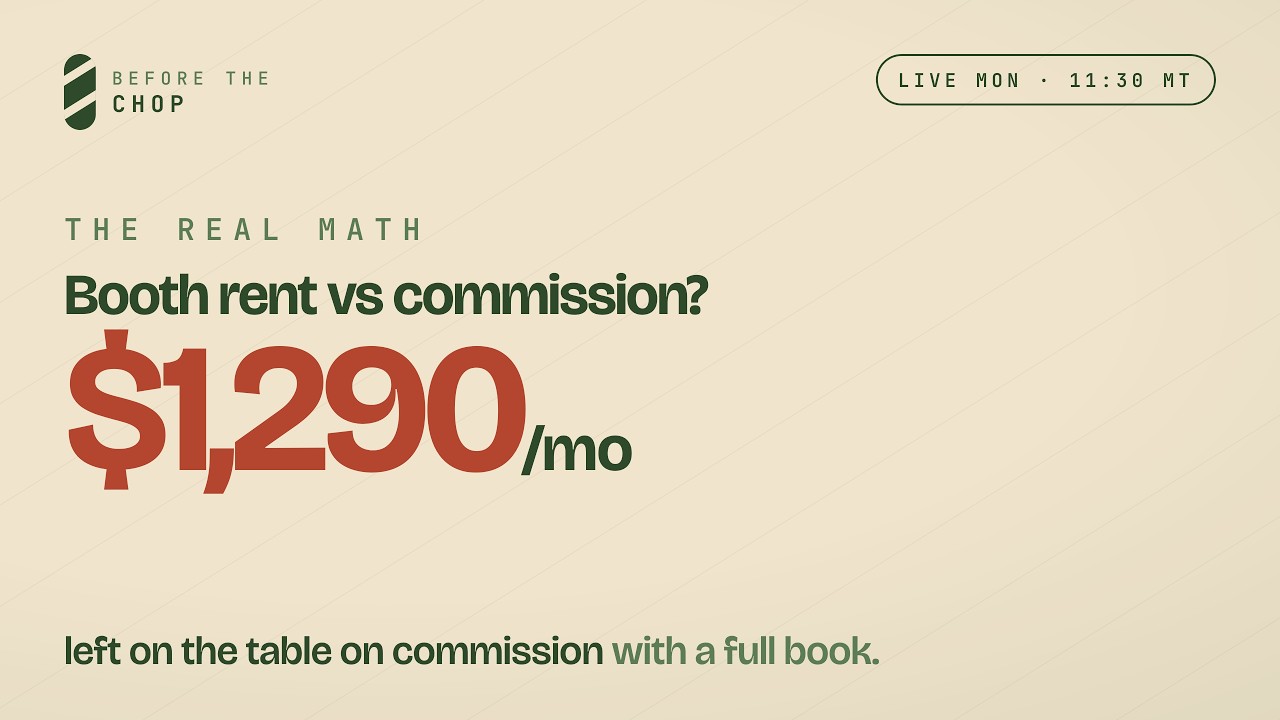
A barber with eight steady clients jumping onto a $600 seat is paying rent just to tread water. But a barber with twenty-five steady clients still sitting on a 50/50 split is leaving roughly $150 a week on the table, about $600 a month staying in a shop that should be staying in your pocket.
I'll be honest with you. I stayed comfortable on booth rent longer than I should have before I started treating my numbers like they mattered. Told myself I'd get serious once the book felt solid. The book was solid. I just didn't want to look.
Booth rent rewards the book you already have. Commission helps you build the book you don't. Mix those two up and you'll make the right move at exactly the wrong time.
The suite: a business with your name on it
The private suite is where the independence logic ends up. Your own fully separate space, a unit in a suite building or your own storefront. All of it is yours: schedule, pricing, branding, the whole client experience. And every bit of the overhead.
The economics are simple and steep. No split, no shared floor, just you and your costs, which in a suite usually run $800 to $1,500 a month and up. The ceiling is high. You stop being a barber in somebody's shop and become a business with your own name on it, an asset that can eventually be worth something separate from your two hands.
The suite is the right move when your book is full and steady, when you've squeezed everything booth rent had to give, and when you're ready to go from growing a book to building a brand. It's the wrong move when you go there because independence sounds good, before the book is there to carry it. Without consistent weekly revenue sitting well above your costs, independence turns into isolation with a bill stapled to it.
And there's a cost the lease never shows. The barbershop was built on what happens when barbers share a room: the new guy watching how a veteran handles a client who's losing his hair and not okay about it, the standard of the floor calibrating everyone standing on it. Four walls and just you, and that stops. Part of why I'm still in a shared shop is the booth math. The other part is that I'm not done learning from the people around me. If you take the suite, take it with your eyes open to both halves: better economics, fewer people to learn from.
Three questions before you lock up tonight
End of the week, last client gone, and you're the last one in the shop. Before you grab your keys, run these three on yourself, the honest kind, where nobody's watching and you don't get to round up.
Question one: am I making more than I'm paying to stand here? On commission, what did the shop keep last month, and is it still worth what you're getting back in clients, space, culture, and brand? On booth rent, is your revenue clearing rent consistently, or are there months where rent eats the whole thing? In a suite, is your monthly take clearing overhead with enough left over that you're building something, not just covering?
Question two: am I actually growing where I am? Not just sharper hands. Book size, name, income. Is the number moving in the right direction, and is the shop speeding that up, slowing it down, or doing nothing at all? If you've felt flat in the same spot for more than a year, the setup deserves a hard look.
Question three: if I were starting over today, would I pick this shop again? Not because it's familiar. Not because the people are fine. Only because it's the right fit for where you're standing right now.
An honest yes to all three and you've found your home. Any no, and you've found the thing that needs your attention. You don't have to move a single thing tonight. But now you know.
The question never changed
For most of a century there was nothing to decide. America's first barber school opened in Chicago in 1893, and the profession that grew out of it ran on one model: you stood in someone's shop and split the take. Commission wasn't chosen. It was inherited, because no other door existed. Booth rental only got real oxygen in the 1980s, when the IRS clarified independent-contractor rules and renting a chair fit them cleanly. The suite came later still, in the early 2000s; Sola Salons, one of the companies that built the model early, was founded in 2004 right here in Denver.
Every generation of barbers has asked the same thing: how do I keep more of what I make? Commission was the answer for a hundred years. Booth rent answered the next thirty. The suite is the answer some barbers are living right now.
Most barbers don't pick the wrong setup because they made a dumb decision. They pick wrong because they decided with no map. You've got the map now. The question was never which one is best. It's which one fits where you're standing, and whether you'd still choose your spot if the choice were in front of you today. It is.
The show, in your inbox.
One email a week: the full episode as a written article, the day it drops. No spam, no selling your address, unsubscribe anytime.