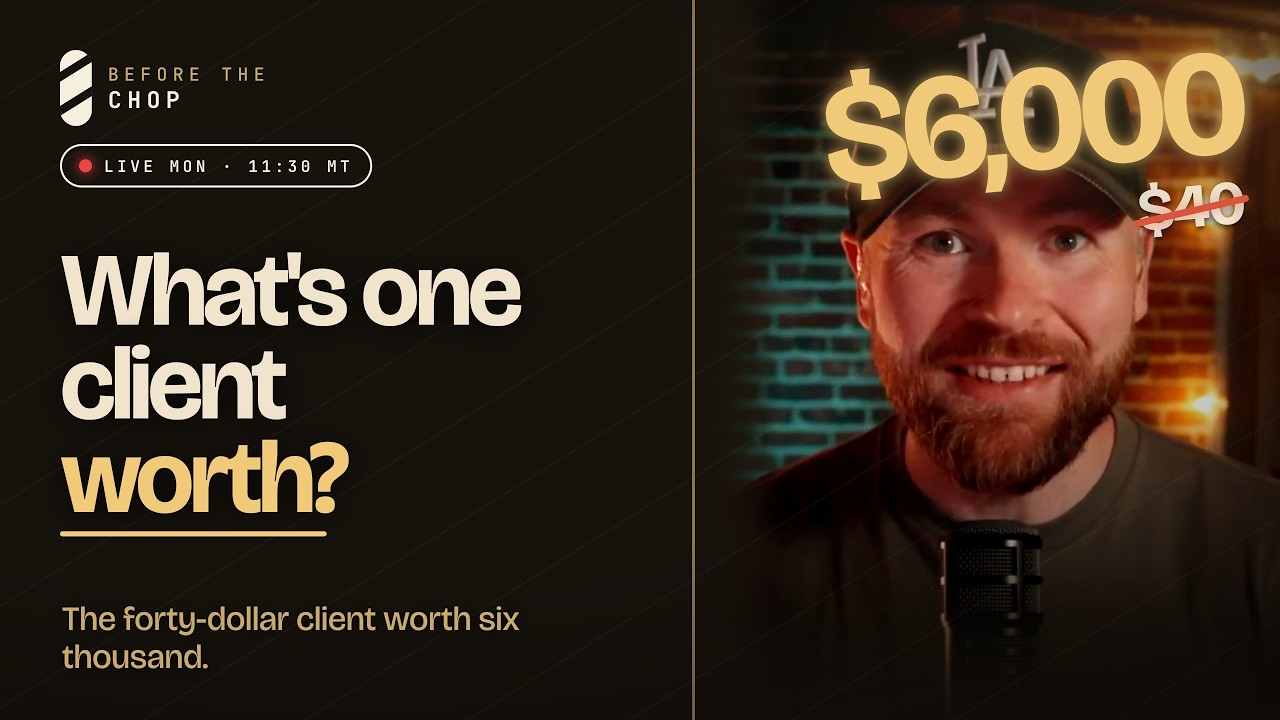
The $40 haircut that's actually a $6,000 client
Three numbers tell you what a client is really worth over the years they stay. Run the math, then use it on rebooks, lapsed regulars, and prices.
 33:31
33:31
Marcus sat in my chair every two weeks for the better part of six years. Good dude, easy cut, never late, never weird. And in all that time I never once asked the only question about him that actually mattered: what is this man worth to me?
Not the forty bucks he set on the counter on a Tuesday. The whole thing. Six years of Tuesdays. I could have told you my booth rent to the penny, in my sleep, backwards. But what the guy sitting right in front of me was worth over those years? I never ran it. Not once. That gap was the most expensive blind spot I ever had as a barber, and this is my attempt to fix yours.
The math I never ran
So let's do the thing I never did. Marcus paid about forty a cut. Maybe one visit in three he'd get his beard done too, or grab a thing of pomade on the way out, so his real average was a little north of forty. That's the first piece: what a typical visit is actually worth, everything in, not just the number on your menu.
Second piece, frequency. Every two weeks is twenty-six visits a year. Not twelve. Twenty-six. This is the number most barbers skip right past, and it runs everything. The guy who comes every two weeks is worth more than double the guy who comes once a month, for the exact same haircut out of the exact same hands.
Third piece, the years. Marcus stayed six. Run it all the way out and he was somewhere north of six thousand dollars walking through my door one ordinary Tuesday at a time. I was looking at forty. The real number had two more zeros on it.
And what did it cost me to get him in the chair the first time? One Instagram post and a buddy's recommendation. Call it twenty bucks of my time, generously. Twenty in, six thousand out. Sit with that ratio for a second.
Then there's the part that makes a Marcus worth more than his own number. The good ones bring people. Marcus sent me his brother, two guys from his job, and his kid the year the kid got old enough to care what his hair looked like. That twenty-dollar post didn't buy me one client. It bought me a whole little tree of people he vouched for me to, each of them with their own six years sitting in front of them. The regular in your chair is the best marketing you will ever have, and he works for free.
Run your own number
Pick the client who's been in your chair the longest. You thought of their face before you finished reading the sentence.
Now, three numbers. What's a normal visit with them actually worth, once you count the beard trim they get sometimes, the product on the way out, the cash tip if it's a cash guy? Round it. How many times a year do they come in? Every two weeks is twenty-six, once a month is twelve, every three weeks is about seventeen. And how many years have they been coming?
Multiply the three together. Say your guy averages forty-five a visit and comes every three weeks. That's already about seven hundred and sixty dollars a year off one person. Four years in, he's a little over three thousand dollars. One client. Three grand you've probably had filed in your head this whole time as a forty-five-dollar haircut.
I'd bet money your number is four figures. For some of you it's five. You've been carrying that person around as a forty-dollar cut, and they were never that.
Once you have the number, decisions that used to be agony answer themselves. Should you raise prices? You can see exactly what a small bump does across a six-year client. Stay late for one more walk-in, or go home and text the three regulars who haven't rebooked? You know which one's worth more now. Is that ten-dollar discount cheap or expensive? Depends entirely on whether it's pulling in a new Marcus or shaving money off one you already had.
Fourteen million haircuts say the same thing
This isn't me being sentimental behind my own chair. SQUIRE, the company behind the booking and payment software in thousands of barbershops, put out their State of Barbershops report for 2026, built on nearly fourteen million haircuts across about seven thousand shops. Real behavior, real money, a full year of it.
The headline of their whole report, their words: retention is the real growth driver. The fastest-growing shops in the country right now are not the ones running ads chasing strangers. They're the ones winning the rebook.
Then the number that genuinely stopped me. Per that same report, about forty-eight percent of clients are one-and-done. Nearly half of everybody who sits in a barber's chair never comes back a second time. And the ones who do return come in about every forty-eight days on average, which lands around seven cuts a year.
That's the whole lesson in one stat. Half the people in your chair are a Marcus you never got to build. Every one of them could have been six years of Tuesdays, and instead they were one and gone, and most of us never even clocked which ones walked.
What the number changes tomorrow
A number you don't do anything with is trivia. Three moves, and you can start all three this week.
The rebook. The highest-value ninety seconds in your day is the moment a regular stands up out of your chair. That's when you lock the next one. Not "see you whenever." A real, specific "want to grab the same time in two weeks?" while they're still standing there. You just did the math on what two weeks instead of five is worth across a year. The rebook is where you go collect it. It feels pushy right up until you accept that it's just the job.
The quiet ones. Tonight, pull up your books and find the three or four regulars you haven't seen in a while. Not the ones who got mad and left. The ones who slipped because life got busy and you fell off their mental list. Those are four-figure relationships sitting one friendly text away from walking back in. "Hey man, realized it's been a minute. I've got Thursday open if you want it." That's it.
Your prices, and this one stings. Think about your most loyal client and answer honestly: when's the last time you raised their price? For most barbers the answer is never. The people who've been there longest are usually the ones paying the least, because raising the day-ones feels like a betrayal. Look at what that actually is. You're discounting the clients worth the most and calling it loyalty. A client who's stayed six years didn't stay for the price. They stayed for you, and they'll be fine with a fair raise. The discount isn't loyalty. It's fear wearing loyalty's jacket.
Eleven dollars and a pair of clippers
None of this is new. It might be the oldest thing in the trade.
Alonzo Herndon was born into slavery in Georgia in 1858. Freed at seven into nothing, his family sharecropping, dead broke. At twenty he left home on foot with eleven dollars to his name and about one year of school in his whole life, and the trade he picked up was barbering.
He started with one chair. He got good, he got known, and he kept building until he owned the finest barbershop in the South, a place in downtown Atlanta they called the Crystal Palace. Twenty-three chairs, gold mirrors, chandeliers. The most powerful men in the city sat in them.
Catch the part that matters, though. Herndon never saw a man in his chair as a haircut. He saw the relationship, and he understood that the trust and standing built in that chair were worth more than the price of any single cut. In 1905 he took what those chairs had earned him and bought a failing little insurance company for a hundred and forty dollars. He grew it into Atlanta Life, one of the largest Black-owned businesses in the country, and became the first Black millionaire in the city of Atlanta. That company is still in business today, a hundred and twenty years later.
So when the business world hands you a fancy term like lifetime value, know that barbers have had a word for it the whole time. We called it a regular. The math is new. The thing the math points at is as old as the trade.
The next time someone settles into your chair, try to see what's actually there. Not a forty-dollar haircut. A Marcus. Six years of Tuesdays, thousands of dollars, and a real relationship just getting started. That shift, from haircut to human, is the whole job.
The show, in your inbox.
One email a week: the full episode as a written article, the day it drops. No spam, no selling your address, unsubscribe anytime.